

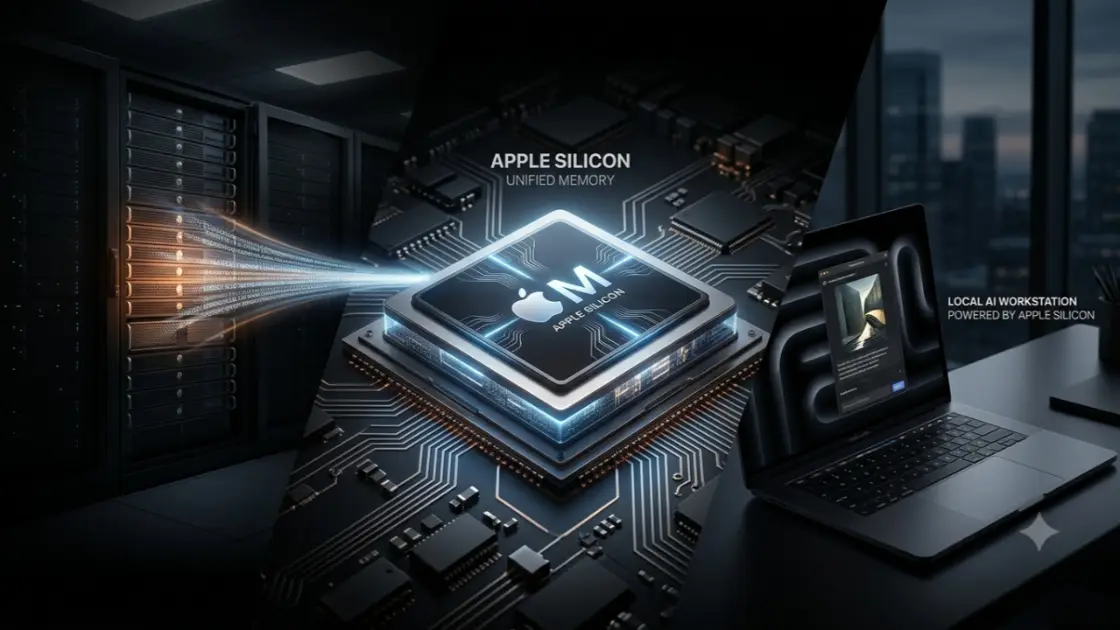
In 1977, computing lived in a room you didn't get to enter. IBM owned the room. You submitted a job, waited in line behind other departments, and got your results on punch cards or a printout hours later. Then Steve Wozniak built the Apple II, and a few years after that Intel's x86 chips and Microsoft's MS-DOS gave every office desk its own computer. The room didn't disappear, but it stopped being the only place computing happened. Power moved to the edge, into homes and onto desks, because the hardware got cheap enough and capable enough to sit next to the person using it.
AI is running the same play in reverse order, and Apple is positioned to be this cycle's Intel and Microsoft rolled into one company.
The data center as the new mainframe
Right now, running a frontier AI model means renting time on someone else's GPU cluster. OpenAI, Anthropic, and Google keep their largest models in hyperscale data centers stacked with Nvidia H100s and B200s, because those models need hundreds of gigabytes of fast memory just to hold their weights, before they process a single token. You send a query over the internet, a data center in Virginia or Iowa does the thinking, and the answer comes back. It's the mainframe model with a browser tab instead of a terminal.
The bottleneck isn't raw compute. It's memory. A GPU can be blindingly fast and still sit idle waiting for weights to move in and out of VRAM, because traditional GPU architectures separate a smallish pool of ultra-fast memory from the system's much larger, much slower main memory. Consumer graphics cards top out around 24 to 32GB of VRAM. Running a 70-billion-parameter model at reasonable precision needs more than that just for the weights, before you add context.
Why unified memory changes the equation
Apple Silicon sidesteps this problem with a design decision Apple made years before anyone was talking about running LLMs on a laptop. Since the M1, Apple has built its chips around unified memory: one pool of RAM that the CPU, GPU, and Neural Engine all access directly, on the same package as the processor. There's no separate VRAM to run out of, and no round trip between system memory and graphics memory. If the chip has 128GB, the GPU can address something close to all of it.
That single design choice, made originally for smoother video editing and app switching, turned out to be the exact architecture a large language model wants. Inference is dominated by memory bandwidth and memory capacity, not raw floating-point throughput. A machine that can hold a 70-billion-parameter model entirely in fast, GPU-accessible memory will often beat a more powerful chip that has to swap weights in from system RAM.
The M5, which shipped in the 14-inch MacBook Pro, iPad Pro, and Apple Vision Pro, put a Neural Accelerator inside every GPU core for the first time, delivering more than four times the peak AI compute of the M4 with unified memory bandwidth of 153GB/s. The M5 Pro pushes that to 307GB/s with up to 64GB of memory, and the M5 Max reaches 614GB/s with up to 128GB. Independent benchmarks on Llama 3 70B have shown the M5 Max running at roughly 36 tokens per second, up from 22 on the M4 Max a year earlier. Apple's chip architecture, built for smooth 4K editing, turned out to be almost by accident the best consumer hardware for running a large model on your desk.
Apple's roadmap just tilted toward AI
Apple's usual chip cadence runs base, Pro, Max, Ultra, once a year, and repeats. That cadence just broke. According to Bloomberg's Mark Gurman, Apple will ship a base M6 on a 2-nanometer process before the end of 2026, but it's skipping the M6 Pro and M6 Max entirely, something the company has never done since the Apple Silicon transition began in 2020. In their place, Apple is fast-tracking an M7 family built specifically around AI workloads, pulling the launch forward by roughly six months.
The base M6 is reportedly targeting close to 200GB/s of memory bandwidth. The M7, expected in the first half of 2027 with Pro, Max, and Ultra variants following through 2028, is said to target around 240GB/s at the base tier, with the M7 Ultra designed to support up to 1.5TB of unified memory and to approach the AI performance of dedicated accelerators like Nvidia's Blackwell line. Before that generation lands, Apple is reportedly preparing an M5 Ultra with around 36 CPU cores and 80 GPU cores, tested in configurations supporting up to 768GB of unified memory, for a next-generation Mac Studio.
Those aren't laptop specs. They're data center specs, shrunk to fit under a desk.
The DRAM shortage is the tell
There's a detail in the recent reporting that says more about where this is headed than any single benchmark. Apple pulled the 512GB memory option from the M3 Ultra Mac Studio in March 2026 and raised the price of the 256GB configuration by $400, and supply chain constraints have since pushed the M5 Ultra Mac Studio's release into question, with some configurations reportedly capped at 96GB. The cause is a global DRAM shortage driven by hyperscalers buying up high-capacity memory for their own AI data centers.
Apple and the cloud AI providers are now bidding for the same scarce resource. That's not a coincidence. It's confirmation that unified, high-capacity memory has become the strategic chokepoint for AI, in the data center and on the desktop alike. Whoever controls memory supply and memory architecture controls where AI actually gets to run.
What this means, concretely
A developer today can run a 70-billion-parameter open model on a MacBook Pro, entirely offline, with no API bill and no data leaving the device. That wasn't practical eighteen months ago. As the M6 and M7 generations roll out with more memory bandwidth and higher capacity ceilings, the size of model you can run locally, and the speed you can run it at, keeps climbing toward what a cloud data center offers today.
This doesn't eliminate data centers, the same way PCs didn't eliminate mainframes. Banks and airlines still run mainframes in 2026. But the center of gravity moved. Most computing that mattered to most people moved to the desk, then the lap, then the pocket. AI is on the same trajectory, and the constraint that decides how fast it gets there isn't clever software. It's who can put the most fast memory next to a chip and sell it at a price a person can afford. Right now, that's Apple's game to lose.